What is menstruation?
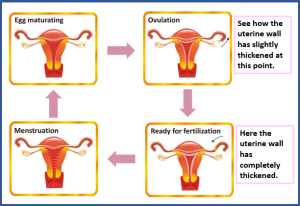
Menstruation takes place when a mature egg is released from one of the ovaries and travels along the fallopian tube towards the uterus. As there is potential for pregnancy, the lining of the uterus, called the endometrium, which is filled with blood vessels, thickens and prepares to nourish a fertilized egg.
If the egg is not fertilized, pregnancy does not occur. The uterus then sheds the thickened uterine lining [endometrium] as menstrual blood which flows out through the vagina over a period of 3-7 days.
The time from the beginning of one period to the beginning of the next is called the menstrual cycle. A healthy menstrual cycle can last as short as 21 days or as long as 35 days.
A girl usually experiences her first period between the ages of 9 and 14. Menstruation is nothing to be ashamed of, it is a biological process.
- On the day of their period, a girls may wear a pad, go to school, play sports, bathe, and eat meat and fish as usual.
- Some people believe that menstrual blood is unclean. On a cellular level it is no different to the blood that flows from a wound.
- If there are complications related to the reproductive system or hormone-related problems, the menstrual cycle may become irregular.
- During pregnancy, menstruation does not occur. The uterine wall [endometrium] remains as it is required for fetal development.
When does menstruation start and stop?
A girl can have her first menstruation between the ages of 9 and 14. The exact age at which this occurs varies. After her first period a girl menstruates every 29 to 31 days.
During pregnancy menstruation does not occur and begins again after the baby is born.
Menstruation may stop between the ages of 40 and 50, and this similarly varies from one woman to another. This process is called menopause.
How long does menstruation last?
A girl’s period usually lasts for 3 to 5 days. It is normal for menstruation to be irregular in early years. During this time, the duration of menstruation can vary from 2 to 7 days. It may take at least a year to establish a regular cycle.
How long is a menstrual cycle?
The menstrual cycle is calculated from the first day of your period to the first day of the next period. Most women have a menstrual cycle that is between 21 and 35 days.
How to deal with menstrual blood?
During menstruation, menstrual blood should be properly collected and disposed of by using any of the following menstrual products:
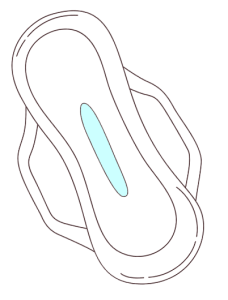
Disposable pads
This is an absorbent sanitary napkin worn between the vagina and underwear.
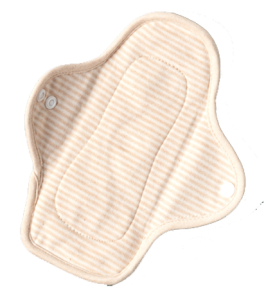
Washable and reusable sanitary napkins
This is a sanitary napkin made of cloth that is applied similarly to disposable pads, with advantage that they can be washed, dried in the sun, and reused.
Tampon
This is a menstrual product that is inserted into the vagina to absorb menstrual blood.

Cup
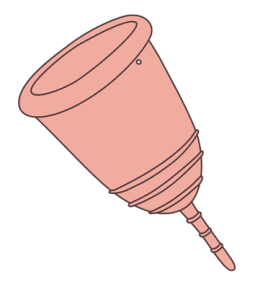
This is a bell-shaped cup, usually made of silicone, is inserted into the vagina to collect menstrual blood. The menstrual cup can be washed and reused.
Don’t forget to wear clean underwear during menstruation – just like on other days.
How to dispose of used sanitary napkins or tampons?
Disposable pads and tampons should never be flushed down the toilet. Since they do not decompose, they can clog pipes. Disposing of non-degradable sanitary products in the environment causes environmental damage. They emit toxic fumes when burned, and if buried, they harm the organisms in the soil, make the soil infertile, and block natural water sources. The best way to dispose of them is to incinerate them. You can also request an incinerator for your school.
It will help the environment if you switch to using an eco-friendly reusable sanitary napkin or menstrual cup.
How to use a menstrual cup?
A menstrual cup is a bell-shaped sanitary device made of natural rubber or silicone that is inserted into the vagina. When inserted correctly, it tightly seals off the vagina and collects blood with no spillage occurring.
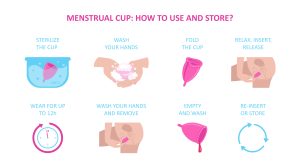
Insert and Removal Instructions.
Visit the happy bleeding Instagram page to learn more.
What should I do when I get my first period?
Don’t be afraid. Don’t be alarmed. Menstruation is a normal and natural process.
If you are at school, tell a trusted teacher. They will give you a pad to wear. In Sri Lanka, the school may contact your parents and send you home. But this is not necessary. You can wear the pad, get on with your school day, and go home at the usual time.
If your first period occurs at home, and your mother or father is not there, speak to a trusted adult and ask for a pad. It is possible that you will be advised to stay indoors until your parents return. This is not necessary. You can wear the pad and get on with your day.
Due to the various cultural customs and rituals associated with menstruation, the first period can be a very scary experience for many children. To avoid being scared or confused speak early with your parents, ask them questions about what happens during the first period.
Sometimes, parents may not have received scientific information about menstruation or may think that cultural customs are mandatory because everyone does it. You can also educate your parents by reading them the information in your Grade 7 Health and Physical Education textbook.
Where do menstrual myths come from?
Before we understood the science of menstruation, this process was considered mysterious and mystical. Before we understood the science, and the biological process of menstruation, humans told each other stories to explain this process. And now, even though science has shown as that these stories are myths, devoid of a scientific evidence-base, these myths prevail.
These myths and misconceptions, based upon a patriarchal religious construct of the woman, perceives menstruation as a weakness, an illness, even a curse. For example, this natural biological process is used by mainstream religions to limit and discriminate against women – framing women as impure and unclean, and therefore second-class citizens when compared to men.
This patriarchal framing of menstruation has led to women accepting and perpetuating this myth of inferiority which limits women and girls and may also lead to issues of low self-esteem that women and girls experience. How would you feel if you’re constantly told that a natural biological function makes you impure and unclean?
How do we dispel myths about menstruation?
Menstruation doesn’t have to be a secret, mystical and mysterious experience anymore. The most effective way to dispel myths and harmful stories is to learn and respond with the science of of the human body works. The information in the Grade 7, 8 and 9 textbooks produced by the National Institute if Education [NIE] contains simple and clear demonstrations of the biological process of menstruation. We can use these textbooks, and/or information on this website, to engage with our peers, our parents, other adults and challenge myth-based statements. Young people who use social media can amplify this information in that space too.